Introduction
At-home beauty tech has boomed, but many gadgets ask premium prices to deliver a single effect. Microcurrent here, LED there—each with a $200–$500 tag. MyoGlow takes a different path by rolling four well-known technologies into one compact tool and bundling it with three ready-to-use serums.
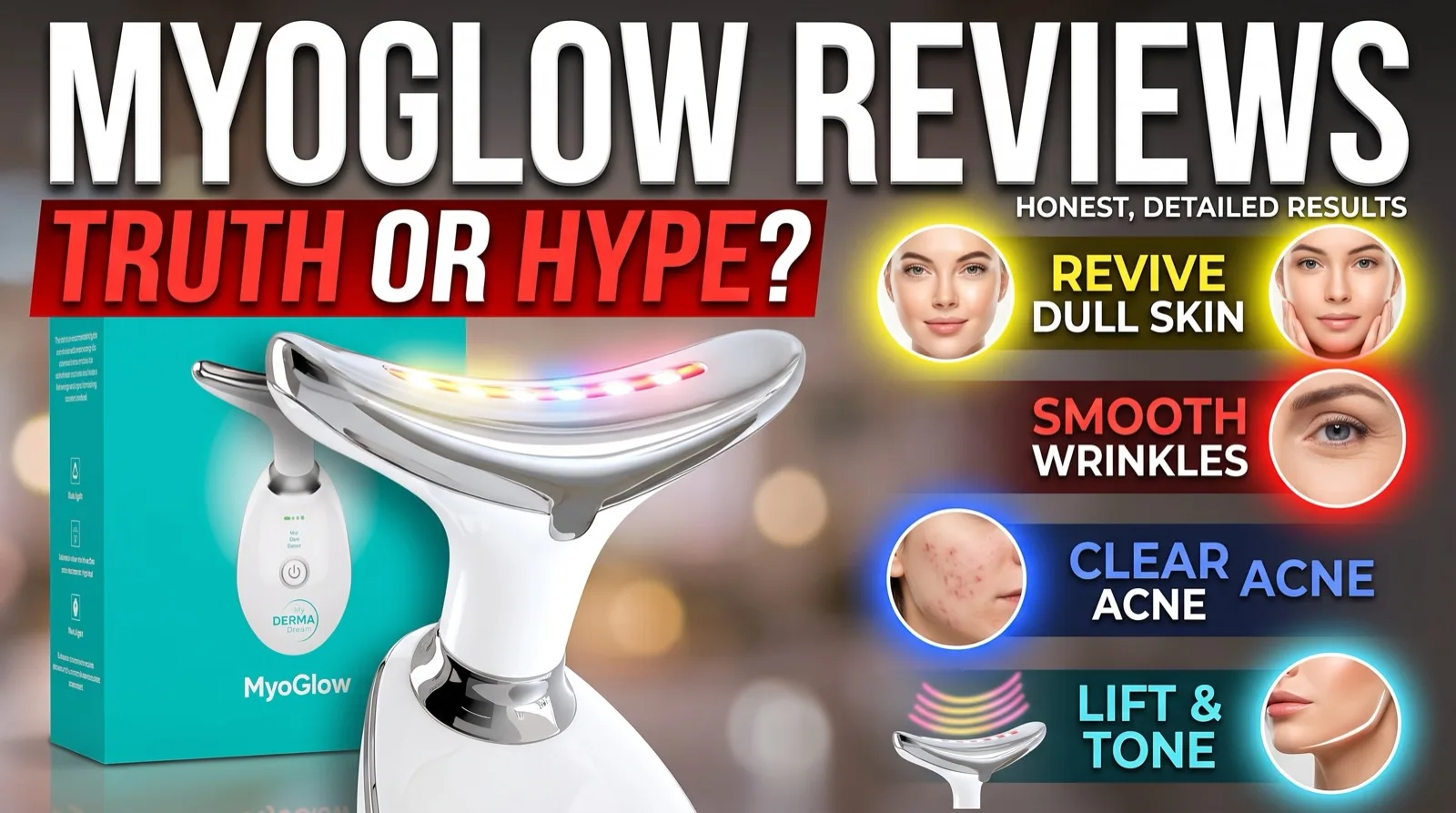
The device blends LED light (red, blue, green/amber), electroporation to help actives get past the skin’s surface, gentle heat, and sonic vibration. It’s currently promoted at $119 for the Trio bundle, which undercuts most rivals by a wide margin.
Over six weeks, this review examined how it performs across face, jawline, and neck, comparing changes in texture, firmness, and puffiness versus the claims and published research. Expect a clear-eyed look at what’s real, what’s marketing, and where this 4-in-1 approach makes sense next to microcurrent-led options in the home tightening arena.
The goal: judge each technology on its own merits and then as a combined routine, while also checking whether the included serums meaningfully complement the device—or just pad the box.
TL;DR / Verdict
- Works, with caveats: the techs are supported individually by research; combined results build slowly but are noticeable.
- Timeline: early texture gains around weeks 2–3; skin that looks a bit firmer by weeks 4–6 with daily sessions.
- Comfort: very easy to tolerate—pleasant warmth and relaxing vibration.
- The trade-off: expect subtle, steady progress, not a dramatic overnight change.
- Best for: value seekers who want multiple technologies in one device instead of paying $300–$500 for a single specialty.
- Not for: anyone who won’t use it daily or wants fast, dramatic lifting.
- Rating: 7.8/10
- Deal to watch: the Trio bundle is frequently discounted by 60%.
What Is MyoGlow?
MyoGlow is a handheld device from My Derma Dream designed to simplify at-home treatments by combining four functions: multi-wavelength LED, electroporation to enhance penetration, a warming mode to boost circulation and reduce puffiness, and sonic massage to relax tension and aid contouring.
The Trio bundle includes the device, a USB charger, instructions, and three formulas—NoTox Peptide Serum, Niacinamide 5% Activator Serum, and Glide & Glow Ultra-Creamy Plumping Serum—so you can start right away. It’s promoted at $119 (regularly $299).
The appeal is simple: instead of buying separate tools (for LED, massage, etc.), this one covers several bases in 5–10 minutes a day. The brand emphasizes firmer-looking, better-contoured skin with regular use.
Electroporation is the standout here. Many similarly priced devices skip it, yet it’s the piece that helps active ingredients move beyond the outer skin barrier so they can do more than sit on top.
My Derma Dream cites 200,000+ customers and a 4.9/5 rating across 220 on-site reviews. As with most brand-hosted feedback, scores skew high, while independent chatter is more mixed but still generally positive—especially on value—provided users give it time.
The company frames itself as a bridge between clinic-style tech and approachable at-home care, supporting customers with Masterclasses and a skincare app alongside the hardware.
How MyoGlow Works: The Four Technologies
Four modalities run in concert. Understanding each one makes the overall pitch clearer.
LED Light Therapy
LED uses targeted wavelengths to nudge skin biology. It’s among the better-studied at-home approaches.
- Red (640–670nm): The most researched for aging concerns. It can stimulate fibroblasts, supporting collagen and elastin for smoother-looking skin over time. Studies, including a 2014 paper in Photomedicine and Laser Surgery, report improvements after weeks of use.
- Blue (440–470nm): Targets acne-related bacteria and oil regulation. Helpful for clarity, less tied to “lifting.”
- Green/Amber (565–570nm): Often associated with calming puffiness and supporting lymphatic flow. Evidence is lighter than for red, but the rationale is reasonable.
Electroporation
Brief electrical pulses create temporary pathways in cell membranes so skincare ingredients can move deeper than they otherwise would. Research in the International Journal of Pharmaceutics has shown permeability increases of up to 1000-fold for certain molecules, which is why pairing electroporation with peptides and niacinamide can be meaningful.
Because the stratum corneum blocks so much of what we apply, this step tackles the biggest bottleneck in topical skincare: getting actives where they can matter more.
Thermal Therapy
Gentle heat encourages circulation and helps prime the skin for treatment. It’s comfortable—not hot—and can aid de-puffing while creating conditions that support absorption and LED exposure.
Sonic Massage
Vibration helps distribute product, relieves tension in facial muscles and fascia, and supports fluid movement. Over time, this can soften the look of expression-related lines and contribute to a more relaxed, “awake” appearance. It also makes the routine feel pampering, which can help with staying consistent.
The Claim vs. The Fine Print
“Visibly lifted, firmer-looking skin”
Possible with steady use, but patience is key. Published data on these modalities points to change over 8–12 weeks. In six weeks, expect smoother texture and less puffiness; true “lift” takes longer.
“Professional-grade results at home”
The methods overlap with those used in clinics, though consumer devices run at lower intensities and smaller coverage areas. You can get real improvements, just not the same punch-per-minute as a pro setup.
“No appointments, no needles, no downtime”
Accurate. It’s painless and requires no recovery.
“Just 5–10 minutes daily”
That’s the device time. Add a couple minutes for serum and cleanup. Plan on 10–15 minutes total.
Bottom line: the technologies are legitimate, the bundle is unusually comprehensive for the price, and the marketing oversells speed. Think steady refinement, not a one-week transformation.
Design and Build Quality
The device is compact, lightweight, and easy to hold. The head glides along facial curves without awkward angles. Controls are straightforward, and the USB charging avoids proprietary cables. LEDs and mode indicators are clear and readable.
Coverage is smaller than a full-face panel, so you’ll work in sections. For a handheld, the footprint is reasonable, and the build feels solid for the cost—without the dense heft of $400+ devices.
The serums arrive in simple pump bottles. NoTox is the thickest, Niacinamide is fast-absorbing, and Glide & Glow is the creamiest. All pair well with the device; they’re good starters even if you later switch to your own staples.
How to Use MyoGlow: Step by Step
- Cleanse: Start with bare skin. Makeup and sunscreen can block light and hinder absorption.
- Serum: Pick based on needs—NoTox (firming), Niacinamide (clarity/oil), or Glide & Glow (hydration). Apply generously to the area you’ll treat.
- Power on: Choose a mode and begin at the lowest setting. Work up as your skin adjusts.
- Glide: Use slow, upward passes across cheeks, jawline, and neck (2–3 minutes per zone). The warmth and vibration make it comfortable.
- Finish: Follow with moisturizer; in the morning, use SPF. Enhanced absorption can make your routine feel more effective.
Testing Methodology
The six-week schedule used one session nightly, rotating through the three included serums—roughly two weeks per formula. Progress was monitored via weekly photos under consistent lighting and by tracking changes in texture, perceived firmness, puffiness, and overall radiance.
Practical factors such as ease of use, comfort, battery life, and routine fit were also noted. The tester profile: 30s, combination skin, mild fine lines around the eyes, and occasional jawline puffiness. Previous at-home experience included a basic LED mask but not a multi-tech tool.
Use mirrored real life—tired nights, on-the-go sessions, occasionally rushed application. One week included travel; the small footprint and USB charging made packing simple.
Real-World Performance: Week by Week
Weeks 1-2: Getting Started
The first days are about finding rhythm—how slowly to move, how much pressure to apply. The heat is pleasant, vibration is relaxing, and skin often feels softer after sessions, likely thanks to massage and better product spread. By the end of week two, skin looked a touch brighter; NoTox felt the most cushioning on application.
Weeks 3-4: Noticing Changes
Around week three, morning puffiness eased and the jawline looked a bit more defined in photos. Makeup sat more evenly. Side-by-sides from week one versus four showed smoother texture and a slightly softer look to nasolabial folds—subtle but visible when compared directly.
Weeks 5-6: Consolidation
Improvements held and inched forward—skin along the jawline felt a bit firmer, texture was more refined, and the overall look more rested. One noteworthy pattern: skincare used after sessions seemed to deliver more, consistent with what electroporation is designed to do.
MyoGlow vs. Competitors: How It Stacks Up
Compared with NuFACE Trinity+ (~$299), ZIIP HALO (~$495), and FOREO Bear Pro (~$399), MyoGlow stands out on breadth and price. It packs LED (three wavelengths), electroporation, thermal, and sonic into one unit, and includes three serums. NuFACE focuses on microcurrent; ZIIP blends microcurrent with nanocurrent and deep app guidance; FOREO combines T‑Sonic pulsations with microcurrent.
NuFACE and ZIIP have more published device-specific data and FDA clearance (NuFACE, ZIIP) in the microcurrent category. MyoGlow’s strength is value and variety without an app dependency. If clinical evidence for the exact device and FDA status matter most, premium microcurrent tools lead. If you want many technologies at a budget-friendly entry point, MyoGlow makes sense.
The Serums: What’s Actually Inside
The included trio is practical for getting started and plays nicely with electroporation.
NoTox Peptide Serum
A peptide-focused formula aimed at firmness and smoothing fine lines. In use with the device, it offered the most “substantive” feel and aligned with the texture improvements seen over time.
Niacinamide 5% Activator Serum
At 5%, niacinamide supports oil regulation, more even tone, and minimized-looking pores. Lightweight and quick to absorb—an easy daytime pick, particularly for combination or oily skin.
Glide & Glow Ultra-Creamy Plumping Serum
Hydration-forward with hyaluronic acid and moisturizers. It cushions the glide and gives a short-term plump look to the skin’s surface—especially helpful if you’re dry or dehydrated.
They’re good companions to the device rather than standalone “holy grails.” Feel free to swap in your own favorites later—the electroporation benefit still applies.
Tips to Get the Best Results
- Daily beats sporadic: short, consistent sessions compound over time.
- Always start on clean skin so light and actives aren’t blocked.
- Don’t skimp on serum—conductivity and slip matter.
- Move upward and outward to support a lifted look.
- Give it 8–12 weeks before judging long-term changes.
- Charge every few days; expect ~4–5 sessions per charge.
- Spend extra time where you want change most (jawline, under-eyes, forehead lines).
- Wipe the head after each use to keep LEDs unobstructed.
- Wear SPF in the morning; post-treatment skin can be a bit more UV-sensitive.
Troubleshooting Common Issues
Weak or inconsistent feel: Clean the treatment head and ensure full skin contact. Product buildup can reduce effectiveness.
No change after four weeks: Many see early texture shifts around weeks 3–4, but more defined contour/firmness typically needs 8–12 weeks. If daily consistency still yields nothing by week eight, it may not suit your skin goals.
Dryness post-session: Follow with a hydrating moisturizer. Glide & Glow helps counter temporary moisture loss.
Redness or irritation: Mild flushing soon after use can be normal. If it lingers beyond 30 minutes or stings/itches, shorten sessions or reduce frequency. If it persists, stop and consult a professional.
Battery dies mid-routine: Top up every 3–4 days to avoid interruptions.
Serum sinks in too fast: Apply a thicker layer or lightly mist skin with water first for more slip and conductivity.
Comparison to Professional Treatments
LED panels in clinics: High-irradiance panels deliver more energy, faster—but cost $100–$300 per visit. MyoGlow can’t match that intensity per minute, yet long-term at-home use is far cheaper.
Med spa microcurrent facials: Often produce an immediate, short-lived lift (3–7 days) for $200–$400. MyoGlow leans gradual and cumulative rather than dramatic and temporary.
At-home microcurrent (NuFACE, ZIIP): Direct competitors for toning effects. MyoGlow trades microcurrent for breadth (LED/electroporation/thermal/sonic) at a much lower price.
Chemical peels: Big renewal, some downtime, different goals. MyoGlow addresses puffiness, product absorption, and steady refinement—less intense, no downtime.
In short, it’s a middle path: more comprehensive than one-trick home gadgets, far gentler (and cheaper over time) than clinical sessions.
Who Should Skip MyoGlow
- Anyone wanting a big change in under a month for a specific event.
- Those with active, severe acne—heat and vibration can aggravate inflamed lesions.
- Rosacea-prone or ultra-reactive skin—warming and massage may trigger flushing.
- Shoppers expecting the serums alone to deliver dramatic results—the device is the main driver here.
- If you know you won’t keep up with daily use.
Who Should Buy MyoGlow
- You want multiple technologies in one unit without paying premium prices.
- You’ll commit to daily sessions for at least eight weeks.
- You want to target texture, puffiness, absorption, and general firmness together.
- You like that starter serums come in the box.
- Value for money is your top priority.
Side Effects and Safety
Designed for all skin types, including sensitive and mature. The warming is gentle and the routine is comfortable. A few notes:
- Light sensitivity: If you use photosensitizing meds (e.g., certain antibiotics, retinoids, Accutane), speak with a dermatologist before LED use.
- Pregnancy: The brand doesn’t offer specific guidance—consult your doctor first.
- Skin conditions: With rosacea, eczema, or active breakouts, consider LED only at first and introduce warmth/sonic carefully.
- Electroporation and implants: If you have a pacemaker or similar device, avoid electroporation; you can still use LED/sonic.
Pricing, Discounts, and Value
The Trio bundle is promoted at $119 (regularly $299), a recurring 60% discount the brand runs often. Compared to single-tech devices that cost more without LED or thermal modes, the value proposition is strong—especially with three serums included.
A 90-day Glow Guarantee allows an exchange if you’re not satisfied after giving it a fair run. Orders over $100 ship free (3–5 business days typical).
Given the feature set, the per-technology cost is hard to beat at this price—even if your results are modest. The serums add roughly $60–$80 in standalone value.
Deep Dive: The Science Behind Each Technology
Here’s what the literature says about the core components.
LED Light Therapy Research
Red light in the ~630–670nm range is the most supported for aging concerns. A 2014 randomized controlled trial (Photomedicine and Laser Surgery) reported significant texture and wrinkle improvements after 12 weeks. A 2017 review in Seminars in Cutaneous Medicine and Surgery concluded LED phototherapy is safe and shows statistically significant gains in texture, tone, and fine lines.
Blue targets bacteria near the surface; green/amber has lighter evidence but plausible effects on fluid and tone. Handhelds deliver less intensity than clinical panels, so sessions must be more targeted.
Electroporation: The Absorption Advantage
As summarized in the Journal of Controlled Release, electroporation creates transient pores that let larger or less-permeable molecules get through the skin barrier. In practice, it can help peptides, niacinamide, and hyaluronic acid reach more effective depths—one reason post-device skincare often feels like it “works harder.”
Thermal Therapy: More Than Just Warmth
Research in the Journal of Cosmetic and Laser Therapy indicates warming skin to around 40–42°C can increase blood flow by 30–50%. That supports oxygen and nutrient delivery while making diffusion and LED penetration more efficient. Warmth also encourages lymphatic movement, helping reduce puffiness.
Sonic Massage: The Contouring Component
Sonic vibration provides mechanical stimulation that aids lymphatic drainage and can ease fascial tightness. One study (Journal of Clinical and Diagnostic Research) linked facial vibration massage with reduced cortisol and improved appearance over eight weeks. Practically, it supports a fresher, less puffy look and helps maintain consistency by making treatments feel good.
MyoGlow vs. NuFACE: The Head-to-Head
NuFACE is microcurrent-only, designed to stimulate facial muscles. MyoGlow swaps microcurrent for LED, electroporation, thermal, and sonic. Both are comfortable; MyoGlow’s warmth adds a spa-like feel.
NuFACE boasts the deepest bench of device-specific data and is FDA cleared. MyoGlow leans on the established science of its individual components. Results differ: NuFACE users commonly report more noticeable “toning,” while MyoGlow users cite broader skin-quality improvements and de-puffing. Price-wise, MyoGlow is the budget pick, especially with serums included.
MyoGlow vs. ZIIP HALO: Premium vs. Value
ZIIP HALO merges microcurrent and nanocurrent with extensive app protocols—premium tech at a premium price (~$495). Nanocurrent operates at very low intensities and may encourage unique cellular responses. MyoGlow doesn’t offer an equivalent but counters with multiple non-current modalities and simplicity (no app).
Choose ZIIP if you want cutting-edge current tech and guided programs. Opt for MyoGlow if cost, ease, and variety matter more.
MyoGlow vs. FOREO Bear: The Lifestyle Pick
FOREO Bear Pro (~$399) combines T‑Sonic pulsations with microcurrent and an Anti‑Shock System, all via an app. It’s sleek and design-forward. MyoGlow is more utilitarian but adds LED and electroporation at a far lower price. If you love polished app experiences and microcurrent, FOREO fits. If you want multi-tech breadth without app dependency, MyoGlow has the edge.
Brand Reputation and Customer Support
My Derma Dream reports 200,000+ customers and supports users with bi-weekly skin consultations, a free Masterclass series, and a habit-tracking app. Reviews suggest responsive support. The 90-Day Glow Guarantee outpaces many competitors (NuFACE at 60 days, ZIIP at 30 days). The company operates independently and isn’t tied to NuFACE.
Long-Term Value and Cost Per Use
At $119 and a 2–3 year expected lifespan, daily use for two years equals roughly $0.16 per session. Three bundled serums (estimated $60–$80 of value) further sweeten the deal. Replacement serums run ~$20–$80 and typically last 4–6 weeks with daily use, though you can swap in your own products.
Compared to one or two spa visits, the device effectively pays for itself—then keeps going.
The Bottom Line: Is MyoGlow Worth It?
No miracles here—just four credible technologies working together in a friendly, low-friction routine. LED has solid backing; electroporation helps actives penetrate; gentle heat and sonic massage add comfort and practical benefits like de-puffing. The serums make it turnkey from day one.
You’re trading brand prestige and device-specific clinical dossiers for price and breadth. If you value slow, steady improvements and cost-efficiency, the risk-reward looks good—especially at the $119 promo with a 90-day guarantee.
Final Verdict
Score: 7.8/10. A smartly priced, multi-technology tool that delivers visible but gradual gains and includes starter serums. Its weak spots are the lack of independent clinical studies on the combined device and marketing that overshoots timelines. If you bring patience and consistency, it’s a worthwhile add to an at-home routine.
Key Specifications
Device Type: 4‑in‑1 (LED, Electroporation, Thermal, Sonic)
LED Wavelengths: Red 640–670nm; Blue 440–470nm; Green/Amber 565–570nm
Treatment Time: 5–10 minutes per session
Battery: USB rechargeable
Weight: Lightweight, handheld
Included Serums: NoTox Peptide; Niacinamide 5%; Glide & Glow Plumping
Guarantee: 90‑Day Glow Guarantee
Shipping: Free on $100+ orders
Verdict: 7.8/10—very good, recommended with minor caveats.
Common Questions & Answers
Q: Does MyoGlow actually work for skin lifting?
A: It uses four studied technologies—LED, electroporation, warmth, and sonic massage. Expect gradual improvements in smoothness and puffiness first, with firmer-looking skin developing over weeks of daily use. It’s not a fast lift, but steady gains are realistic.
Q: How long does it take to see results with MyoGlow?
A: Many people notice initial texture and glow changes in 2–3 weeks. More pronounced firmness and contour changes typically need 6–8 weeks of consistent daily use. Skipping sessions slows progress.
Q: Is MyoGlow safe for sensitive skin?
A: It’s designed for all skin types, including sensitive and mature. Always patch test first and ease in if you’re reactive. If you have specific conditions, check with a dermatologist.
Q: What serums come with MyoGlow?
A: Three: NoTox Peptide (firming/anti-aging), Niacinamide 5% (clarity and oil control), and Glide & Glow Ultra‑Creamy Plumping (hydration/texture). They’re formulated to pair with electroporation.
Q: How is MyoGlow different from NuFACE or ZIIP?
A: NuFACE/ZIIP center on microcurrent (and nanocurrent for ZIIP). MyoGlow combines LED, electroporation, thermal, and sonic instead—and costs less, with serums included. The trade-off is less device-specific clinical data.
Q: Can I use MyoGlow with retinol or vitamin C serums?
A: Yes, but go slowly with retinol since it can raise sensitivity. Vitamin C typically pairs well and may absorb better. Avoid using strong actives and the device together if you notice irritation.
Q: How do I clean and maintain the device?
A: Wipe the head with a soft, damp cloth after each use; use mild soap weekly if needed. Don’t submerge. Keep the head clear of buildup to maintain LED output.
Q: How does MyoGlow compare to DIY LED masks from Amazon?
A: Budget masks may have inconsistent wavelengths and lack add-ons like electroporation, heat, and sonic modes. MyoGlow offers calibrated LEDs plus multiple functions and generally better build quality.
Q: Can men use MyoGlow?
A: Absolutely. Men’s thicker skin may benefit from slightly longer passes. Clean the device head more often if using over facial hair.
Q: Where can I buy MyoGlow and is there a guarantee?
A: It’s sold through the brand’s official site. The Trio bundle is promoted at $119 (down from $299) and comes with a 90‑Day Glow Guarantee. Buying direct helps ensure authenticity and support eligibility.
More Wellness Gadgets Reviews
- Nooro Knee Massager Review 2026: 21 Nights of Testing — Nov 4, 2026 — 7.2
- Qinux FootRevita Review 2026: 4 Weeks of Real Foot Testing — Nov 4, 2026 — 6.8
- Rangii Review 2026: 21 Nights of Nail Fungus Testing — Nov 4, 2026 — 7.2
Related Guides & Articles
- Best Sleep Masks 2026: 5 Tested and Ranked
- Best Sleep Masks for Side Sleepers 2026: 5 Tested
- Sleep Ease vs Dodow: Two Drug-Free Ways to Fall Asleep Faster
Browse all 85 wellness gadget articles. About the reviewer: Dr. Sarah Kim, PhD in Biomedical Engineering, focuses on health tech and wellness devices with a data-driven lens.